
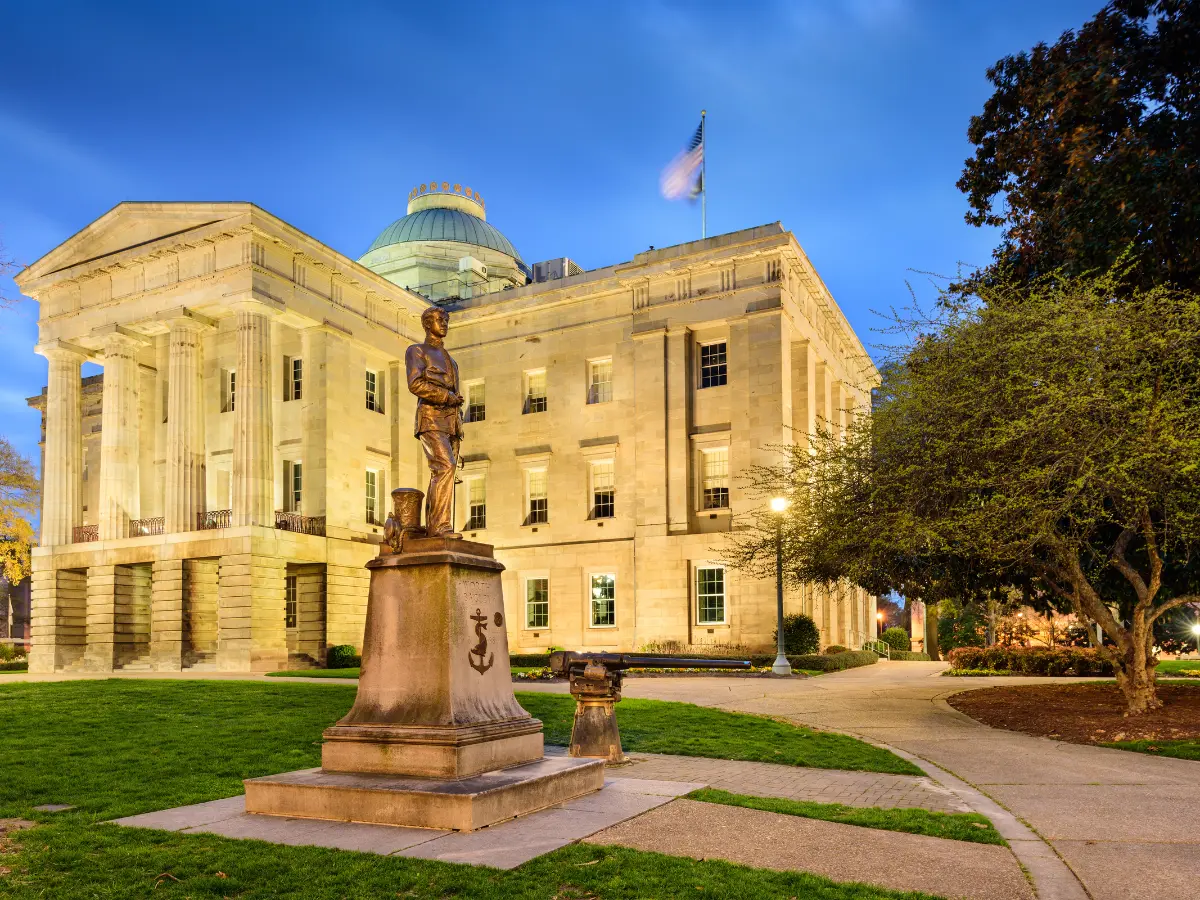
Why Was Raleigh, NC Chosen as the State Capital Instead of Other Cities?
Many think our government was always here. But, history shows a search for a safe, permanent spot in 1792. We often miss how politics shaped our state’s layout.
Leaders had to choose between busy cities and empty land. They picked safety and easy access over buildings. Strategic planning led to this choice, ensuring our area’s growth.
Join us as we dive into these interesting events. Learning about our past helps us see how our city grew. Let’s uncover the reasons behind this historic choice together.
The Search for a Permanent Seat of Government
The early days of our state government were marked by constant movement. Before settling on a fixed home, officials faced challenges in conducting business without a central base. This era of North Carolina capital history offers a glimpse into how our ancestors dealt with political uncertainty.
The Era of the Traveling Capital
During the Revolutionary War, the legislature had no permanent office. To avoid British soldiers, they moved between six locations, including Halifax and Hillsborough. This nomadic lifestyle made it hard for citizens to follow legislative progress or get involved in local governance.
The constant moving caused frustration for officials and the public. It was hard to keep records and coordinate defense efforts. This showed the need for a reliable capital city selection NC process.
The Need for Stability After the Revolutionary War
After the war, finding a permanent home became a priority for state leaders. They saw that a growing state needed a stable, central location for unity and efficient administration. Without a fixed capital, the government couldn’t meet the needs of its growing population.
Creating a permanent seat of government was key for long-term growth and order. By moving away from temporary solutions, leaders aimed to build a lasting legacy. This shift was the main reason for the eventual capital city selection NC that shaped our future.
Why is Raleigh the capital of North Carolina?
Many wonder why Raleigh was picked as the capital. It wasn’t just for convenience. It was a smart choice to secure our state’s government future. Understanding the history helps us see why Raleigh is the capital today.
The Legislative Mandate for a Central Location
In 1788, leaders knew the government needed a safe, permanent home. Coastal towns were at risk of naval attacks. The legislative mandate required a site that was centrally located to keep power safe and accessible to all.
Evaluating Possible Sites Across the State
Commissioners had to find the perfect spot for the state’s heart. They looked at many places, considering what was best for a growing population. Fair representation was a top priority, aiming to unite eastern and western interests.
The Influence of Geography on Political Accessibility
The Piedmont region’s geography was a big plus. It offered a safe spot away from the coast. This strategic placement fostered political unity and turned a quiet oak grove into our state’s bustling center.
The Competition Between Coastal and Inland Interests
Choosing a home for our government was a tough task. It had to balance the needs of coastal elites and frontier settlers. This time in NC government history Raleigh was filled with deep regional divides. These divides shaped every big political decision.
The Dominance of Eastern Power Centers
For years, the eastern part of the state had the most political power. Wealthy planters and merchants in the east controlled the legislature. They wanted to keep the government seat near the coast.
Access to trade routes was key for these leaders. They thought a capital city needed to be near major ports. This made it hard for inland areas to get a say in the debate.
The Rising Voice of the Western Frontier
As the population grew, the western frontier wanted more say in the capital city selection NC. Settlers in the west felt left out by the eastern-dominated government. They wanted a capital that served all citizens, not just the coast.
This change in demographics made politics tense. Westerners pushed for a location that was accessible to all. Their growing influence made the state rethink its traditional governance.
Finding a Compromise in the Piedmont Region
Fayetteville was a strong contender because it was a commercial hub with access to the Cape Fear River. Many thought it was the natural choice for a permanent capital. But the legislature wanted a solution that pleased both the east and the west.
In the end, the decision to build a new city in the Piedmont was a strategic political compromise. Some doubted the long-term success of a non-commercial capital. But the state went ahead with the plan. It aimed to unite the state by placing the government in a neutral, central location.
The Strategic Selection of Isaac Hunter’s Tavern
When we look at why Raleigh was chosen capital, we find that logistics mattered far more than local folklore. Many people enjoy the popular legend that the site was picked simply because commissioners enjoyed the “cherry bounce” cocktail at Isaac Hunter’s tavern. But this story is just a myth that hides the serious planning behind the decision.
State leaders needed a location that could serve the entire population effectively. They looked for long-term stability and accessibility, not just for fun. By moving past the tavern legend, we can see the deliberate and calculated nature of the state’s decision-making.
The Purchase of the Wake County Land
The actual selection process involved a significant land transaction to secure a permanent home for the government. Commissioners successfully purchased 1,000 acres of land from Joel Lane. This large tract provided enough space to build a grand state house and organize a functional city grid.
By acquiring this specific property, the state ensured it had full control over the development of the new capital. This land was centrally located, which helped bridge the gap between the eastern and western parts of the state. It served as a neutral ground that could accommodate the needs of a growing legislative body.
Why This Specific Location Won Over Rivals
Several factors made this site superior to other competing locations across the region. One major influence was the proximity to the newly chartered University of North Carolina at Chapel Hill. Leaders wanted the capital to be near this intellectual hub to foster growth and education.
The site also offered a unique balance of accessibility and safety. It was far enough inland to be protected from coastal threats, yet it remained reachable for representatives traveling from distant counties. This strategic positioning proved to be the deciding factor for many officials who were tired of the traveling capital system.
Proximity to Trade Routes and Water Sources
The location was chosen for its intersection of vital trade routes that linked the state’s diverse regions. These paths allowed for the easy movement of goods, mail, and people, which was essential for a functioning government. Having a central hub meant that communication could flow more efficiently to all corners of the state.
Also, the area provided reliable access to water sources, which was a critical requirement for any growing settlement in the 18th century. This combination of infrastructure and natural resources made the site an ideal choice for the future of North Carolina. Understanding these practical factors helps us see why Raleigh was chosen capital as a move toward modernization.
The Lasting Legacy of North Carolina’s Centralized Capital
Raleigh grew from a quiet village to a lively city. This change shows how our leaders wisely picked a neutral spot for our government. Today, you can see this choice in every part of the city.
Looking into North Carolina’s capital history, we see a big focus on making things easy for everyone. By placing the government in the Piedmont, our founders made sure all could easily meet their leaders. This idea of balance is key to our community’s spirit.
Explore Raleigh’s history through its sites and museums. These places show the dream of our early leaders. They wanted a place where everyone’s voice could be heard.
Our capital keeps leading our state towards a better tomorrow. We honor this legacy as we move forward with new ideas. Share your thoughts on how this central spot shapes our state’s identity.